Tinnitus Treatment
Have you ever experienced a phantom ringing, hissing, chirping, whooshing, whistling or buzzing in your ears? If so, you may have tinnitus.
If you suspect that you have tinnitus, the first place to start is by scheduling a Tinnitus Consultation with a Doctor of Audiology. Our Doctors of Audiology are ABA Board Certified CH-TM Certificate Holders, which qualifies them to be experts in creating personalized tinnitus treatment plans. You can schedule a tinnitus evaluation and consultation online with the button below or by calling our friendly Patient Care Coordinators to set up a time to meet with one of our Doctors of Audiology.
How to prepare for the appointment:
- If you have already had a hearing test in the past, please contact the office where you had your hearing evaluation and request a copy of your records. You can either request a copy for yourself and bring your copy with you to your appointment OR you may request your records to be faxed to our office: Seattle: 206-367-1366 Olympia: 360-596-9304.
- Prepare a list of any medications and/or supplements you are taking with the doses and when you began using them.
- Fill out the intake paperwork sent to you by e-mail or arrive 15 minutes early to the office to complete the intake forms and questionnaires.
- Consider bringing a loved one to your appointment for support.
What is tinnitus?
Tinnitus — often referred to as a constant ringing or buzzing in one’s ears — can actually manifest itself in many ways. The sounds people hear, or more accurately, perceive to hear, have also been identified as buzzing, hissing, whistling, swooshing and clicking. Some rare cases have reported people hearing music. Tinnitus is more common than most people think, with 15 percent of Americans experiencing it to some degree.
Causes of tinnitus
Tinnitus can be caused by a number of different things, from other health conditions to medication. Identifying the reason for the sounds you’re hearing can be important to providing the right treatment. Below are some of the common causes of the condition:
- Hearing loss
- Meniere’s disease: This is a disorder of the inner ear that usually impacts hearing and balance, and can also produce tinnitus sounds. While Meniere’s disease is fairly rare, tinnitus symptoms are often reported along with the usual symptoms of Meniere’s disease.
- Ototoxic medication: Some medications can cause tinnitus. Talk with your primary care physician to determine if you are on such medication and to see if an alternative is available.
- Jaw issues: Some jaw issues, including temporomandibular joint disorder, can cause tinnitus. If this is the case, our audiologists can help connect you with the right service provider.
Tinnitus service options
- Holistic Tinnitus Support: This program is based on the cognitive behavioral therapy model and is designed to support those with tinnitus and distressing or negative thought patterns. It is a 4-session program individually designed for each person based on information derived from the initial tinnitus evaluation. Our Doctors of Audiology are ABA certified in Tinnitus Treatment + Management and have all completed CBT certification through Boston University’s Psychology Dept and combined that knowledge with their extensive training in tinnitus management to provide this unique program.
- Mahana Tinnitus™: This evidence-based, self-guided program is designed to improve sleep, focus, and daily function, teach skills to reduce stress and impact of tinnitus on daily life, retrain the brain to be less bothered by tinnitus sounds and shift habits, thinking patterns, and emotional responses. Mahana Tinnitus™ is affordable and is FSA/HSA eligible.
- Tinnitus Evaluation: This appointment is ideally suited for somebody who is experiencing persistent or recurring/bothersome tinnitus (unexplained ringing, hissing, buzzing, etc.) in one or both ears. Duration: 75 minutes. Diagnostic services will be billed to insurance or to the responsible party.
Treatment options
While there is no official cure for tinnitus, there are a number of different treatment options available to find relief, including:
- Hearing aids: Hearing aids are one of the most common and recommended treatment options for tinnitus. Not only can hearing aids address any hearing loss you have that might be causing phantom sounds, they can also be equipped with masking features to override the noise of tinnitus.
- Lenire®: Lenire® is a treatment device proven in a large-scale clinical trial to reduce the severity of tinnitus. Use it from the comfort of home to manage your tinnitus with the help of a qualified healthcare professional. Soothing sounds and gentle pulses on your tongue help you pay less attention to your tinnitus.
- Sound machines: White-noise machines may be recommended as part of your tinnitus treatment plan, particularly if you experience symptoms at night when trying to sleep. These machines emit a white noise that helps you block out the sounds of tinnitus.
- Tinnitus retraining therapy: This treatment is a form of habituation therapy that works to train your brain to ignore the tinnitus sounds. This solution is usually used in combination with other methods, such as hearing aids, to provide relief to chronic tinnitus sufferers.
Don’t let tinnitus impact your day-to-day functions. Talk more with the Doctors of Audiology at Northwest Hearing + Tinnitus to learn about how you can find relief from that annoying buzzing or ringing.

Lenire®
Lenire is an evidence-based treatment device proven to soothe tinnitus.
Use it from the comfort of home to manage your tinnitus with the help of qualified healthcare professionals.
How does it work?
The device plays sounds from headphones and provides gentle pulses to the tongue via a Tonguetip. The sounds and pulses work together to retrain your brain. You pay less
attention to your tinnitus reducing its impact on your day-to-day life.
What is the device?
Bluetooth headphones, which are provided, deliver customised sounds to activate the
auditory nerve to the brain.
Tonguetip
The Tonguetip, specifically designed to treat tinnitus, sits comfortably in the closed mouth. Tiny electrodes on the Tonguetip deliver mild and safe energy pulses to the surface of the tip of the tongue.
Controller
A lightweight handheld device that controls the timing and intensity of the treatment. You can start, pause and resume the treatment session, adjust the volume of the sound, and adjust the level of the tongue stimulation.
The settings are customised by your healthcare professional to suit your tinnitus after an assessment to make sure you’re suitable.
What is the research behind Lenire?
Lenire is the first device of its kind to receive a grant of approval from the FDA to treat tinnitus. This follows a large-scale clinical trial designed to meet the FDA’s requirements during which 83% of patients recommended Lenire for the treatment of tinnitus. The largescale trial’s results were consistent with real-world evidence from 204 patients*.
How can I get started?
We’re a trained provider of treatment of tinnitus with Lenire. Get in touch today to book an assessment for Lenire.

Levo Medical Provider
Northwest Hearing + Tinnitus is locally owned and independently operated. This means our Doctors of Audiology have the freedom to find a personalized hearing and tinnitus treatment plan for each patient. We strongly believe there is no “one size fits all” solution. NWH+T is a provider of Levo Medical’s Neuroscience Based Tinnitus Treatment as one of the personalized treatment options for our tinnitus patients.

Widex: Zen Therapy
The main objective of the Widex Zen Therapy protocol is to ensure that tinnitus does not negatively affect the client’s quality of life. This is achieved by assessing the needs of the and their hearing profile. Our Doctors of Audiology can assess which of the 4 components should be part of one’s personalized treatment plan.
Tinnitus 101
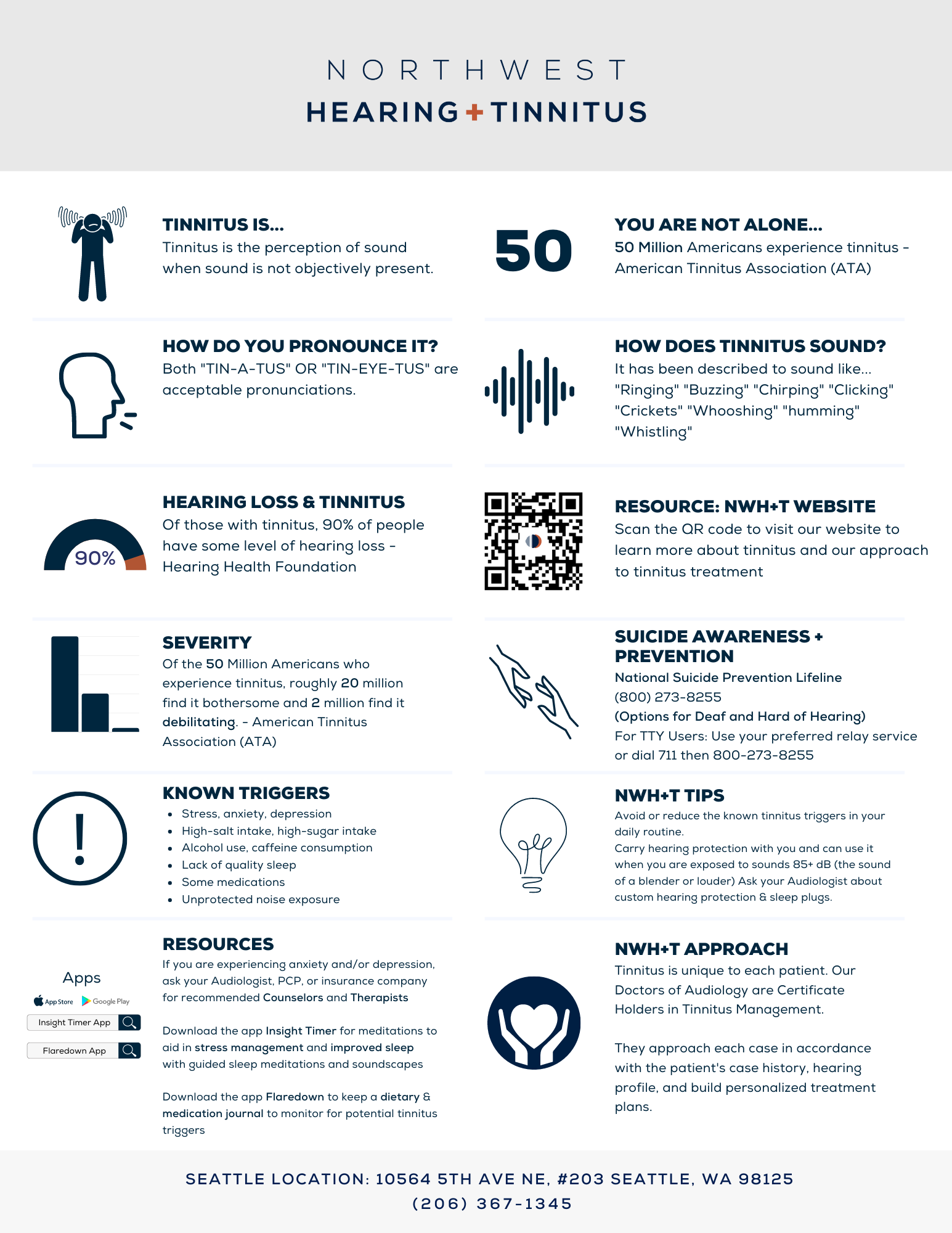
“Millions of Americans experience tinnitus, often to a debilitating degree, making it one of the most common health conditions in the country. The U.S. Centers for Disease Control estimates that nearly 15% of the general public — over 50 million Americans — experience some form of tinnitus. Roughly 20 million people struggle with burdensome chronic tinnitus, while 2 million have extreme and debilitating cases.” –American Tinnitus Association (Data derived from the 2011 – 2012 National Health and Nutrition Examination Survey, conducted by the U.S. Centers for Disease Control and Prevention.)
What is Tinnitus?
Tinnitus (“TIN-a-tus” or “Tin-EYE-tus”) is commonly described as “ringing in the ears” with the absence of an external sound source. Tinnitus can also sound like buzzing, hissing, humming, roaring, whooshing, pulsing, or clicking, and can be heard in one or both ears; or somewhere in the head. Tinnitus is NOT a disease on its own, but a symptom of an underlying cause.
Where does tinnitus come from? What causes tinnitus?
90% of the time, tinnitus stems from hearing loss. Other conditions that might cause tinnitus include: ear infections, noise exposure, migraine headaches, head/neck injury, sleep apnea, TMJ, diabetes, medications, anemia, hypertension, excessive amounts of wax in the ear, certain types of tumors, and/or distress to your nervous system (GAD, PTSD, etc.).
What can make your tinnitus worse?
Primarily, increased damage and untreated hearing loss can make tinnitus worse. There are six triggers of tinnitus that can make it seem louder, or more frequent: excessive stress, lack of sleep and fatigue, caffeine, nicotine, alcohol, and sodium are all culprits in making your tinnitus more bothersome than it already is. In addition to these factors, your own emotional response can cause your tinnitus to flare up, if you fixate on the negatives of the condition.
How is your tinnitus related to hearing loss?
The tinnitus that you hear is usually a result of some problem along the auditory pathway, and the most common source is damage to the hair cells in your cochlea (hearing organ). Typically, when there is more hearing loss, there is more damage. When the hair cells are damaged, they can spontaneously activate without any external sound source present. The hair cells are searching for stimulation, like when they were healthy cells, thus causing the ‘phantom’ ringing we perceive as tinnitus. Many patients report the pitch of their tinnitus in the region where they have the greatest hearing loss.
Why can tinnitus be so bothersome?
Tinnitus can be very upsetting regardless if there is ringing for a few hours after a concert, or if it has been something constantly bothering you for years. Tinnitus can make it difficult for you to hear, concentrate, or even sleep. Tinnitus loudness, pitch, and frequency of occurrence vary between individuals, which can affect how frustrating it can be to describe it to others, to predict its flare ups, or to simply ignore it. When our bodies identify tinnitus as a threat, our “fight or flight” response in the brain’s limbic system activates and releases cortisol and adrenaline — stress hormones. If your tinnitus is causing you stress, the tinnitus will likely worsen due to the stress, resulting in more stress which is usually followed by an increase in the loudness of your tinnitus. A vicious cycle is created and is hard to break without proper treatment and management.
How do we diagnose tinnitus?
Because tinnitus is a symptom, the main goal is to diagnose the underlying condition. Express your concerns for tinnitus and try to be as honest and accurate with your medical history as possible to avoid misdiagnosis or delayed diagnosis. You should schedule a diagnostic hearing evaluation to see if hearing loss may be the root cause of the tinnitus. After the evaluation, your audiologist can recommend further audiological testing, or refer you to other healthcare providers that can assist in providing you relief.
What is a ‘tinnitus assessment’?
The goal of a tinnitus evaluation is for the provider to understand what you’re experiencing, investigate the cause, and develop a treatment plan. The appointment begins with a questionnaire and thorough review of your medical history. We will discuss your tinnitus experience and how it is affecting your quality of life. Then we complete a hearing examination to characterize and quantify the sounds you are hearing. We then take those puzzle pieces and use them to put together a personalized treatment plan for you and your tinnitus.
How can we treat tinnitus?
The most effective way to treat tinnitus is by eliminating or treating the underlying cause. If your tinnitus is diagnosed as a symptom of hearing loss, hearing aids will be recommended as it will correct the hearing loss, help manage the tinnitus, and improve your quality of life through stimulation of the auditory nerve. Being able to hear sounds that were previously missing can make the tinnitus less noticeable as your brain is fixated on hearing as opposed to the tinnitus. If your tinnitus is diagnosed as a symptom in the absence of hearing loss, sound therapy through on ear devices can be utilized for treatment as well. Sound therapy is an option to help patients gradually reduce the loudness and appearance of tinnitus. It is very important to note that proper tinnitus management is a consistent process that may require several months to even years in order to train your brain to habituate to the tinnitus. As a preventative measure in causing damage to your cochlea, hearing protective devices (HPDs) are also recommended to wear in loud, noisy environments. You can buy one-size-fits-all products or purchase custom fit earplugs in many styles through audiologists for best comfort and appropriate sizing.
Sometimes, tinnitus may improve on its own if the case is mild and short-term. After a medical and audiological evaluation, just being able to put the label of ‘tinnitus’ on what patients are experiencing can also help ease your mind, as it validates that there is a true problem. Medical management as prescribed by a physician, such as medication or surgery, may be necessary to treat the root of the problem, before considering additional treatment. Research studies have shown that over-the-counter tinnitus supplements and regimens are not effective in curing tinnitus. In all cases of tinnitus though, patients can benefit from counseling and/or therapy: Cognitive behavioral therapy (CBT) is a form of psychotherapy that can help patients cope with the tinnitus in order to reduce the debilitating effects on daily activities. Continual monitoring and questionnaire checkpoints will be a recommended routine for the observation of progress.
Who can help you?
You do not have to “deal” with your tinnitus alone! In addition to audiologists, there are many medical professionals who can assist in targeting areas in your body and lifestyle to give you the best chance at making your tinnitus more manageable. Support groups are also an amazing avenue in learning and managing your tinnitus. Individuals can share their experiences and coping strategies that can promote hope and control as it sheds light on how many people have to cope with tinnitus. Please ask your Audiologist, Primary Care Physician, or insurance company for professional referrals.
Where can you find help?
We want you to feel like you have resources before, during, and after your appointments with us! Because the internet can send you down a rabbit hole of information, it is hard to know what to believe. You can find additional information and resources through our website, or American Tinnitus Association’s website, ata.org. You may call your insurance company to see which health professionals mentioned above are in-network with your plan, so you can take the steps to a better quality of life.
Tinnitus experiences can be a rollercoaster of emotions, and while there will be good days, there can be bad days as well. A lot of people are able to escape the vicious cycle that tinnitus creates, but others may feel hopeless and that they want to do anything to make it go away. We highly recommend that if you are having thoughts of harming yourself or others, to please call the National Suicide Prevention Hotline: 1-800-273-8255 or visit https://suicidepreventionlifeline.org.
Sources: ASHA – Audiology Information Series, American Academy of Otolaryngology – Head and Neck Surgery Foundation, American Tinnitus Association